Ernie Hidalgo
The Power of the DogErnie Hidalgo is an American policeman and close friend of Art Keller whose work against the drug trade ends in his capture and murder. His death transforms Art’s pursuit of the Barrera organization: what begins as an investigation becomes, in part, a private campaign of retaliation. The story later returns to Ernie not only as a victim of that campaign’s violence, but as one of the dead whose presence forces Art to reckon with its cost.
Background and Motivation
Ernie grew up among gangs in El Paso and saw what drugs did to his neighborhood. That experience gives his work a personal basis: when Art offers him a job in Guadalajara, Ernie accepts eagerly, hoping to do something about the damage he has witnessed. The evidence presents him as someone drawn into the investigation by conviction, not simply assigned to an operation. His commitment also helps explain why he is beside Art during dangerous surveillance, collecting photographs that may document the movement of cartel cargo.
His relationship with Art is both professional and intimate. They share the work of watching the airport, and Art later describes Ernie as a close friend and brother. That bond matters after Ernie disappears: Art’s response is not limited to pursuing information or completing an investigation. He experiences the loss as a personal debt, one that increasingly shapes his actions and his judgment of the wider conflict.
Surveillance at Guadalajara Airport
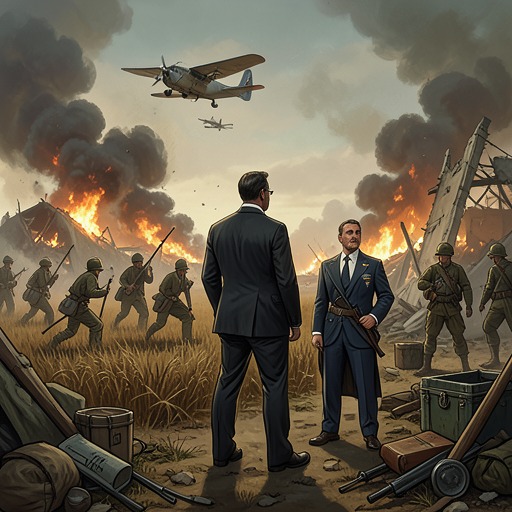
In 1984, Ernie and Art sit in a car on a bluff overlooking Guadalajara airport and watch a DC-4 land. Through night-vision binoculars, Art observes federal police helping unload the cargo. The plane is parked beside a cargo strip, where trucks wait outside hangars; police carry crates from the aircraft and load them into the trucks. Ernie operates a camera to record the activity while Art keeps watch.
The exchange between them is casual, but their task is serious: they are documenting an operation in which uniformed officers handle cargo from the plane. Ernie asks what the crates might contain, and the pair trade joking guesses rather than claim knowledge they do not have. The scene establishes the method of their work—patient observation, photography, and close coordination—before that routine is broken by Ernie’s disappearance.
At a later point in the operation, Art radios Ernie to tell him to expect the return SETCO flight, photograph it, and let it go. Ernie does not answer. The silence marks a sudden rupture in their partnership: Art has given a clear instruction, but there is no confirmation that Ernie has heard it or is safe. The narrative states that Ernie has gone off the radar, leaving Art to search for him without knowing where he has been taken.
Capture and Death
Art eventually learns from Antonio Ramos that Ernie was delivered to Güero Méndez and Raúl Barrera, along with Dr. Álvarez. Ramos believes Ernie may still be alive because Álvarez had formerly worked as an interrogator for the Dirección Federal de Seguridad and, in Ramos’s view, Ernie would be held for information. The report gives Art a reason to continue searching, while making clear that Ernie has fallen into the hands of powerful cartel figures and an experienced interrogator.
Ernie is later found dead in a ditch off a dirt road in Badiraguato. Art looks upon his body and recognizes evidence that he was tortured before he died. The account does not treat the discovery as a detached investigative detail: it places Art face to face with the consequences of his obsession. He asks himself why someone else had to pay for it. The question links Ernie’s fate to Art’s choices without suggesting that Ernie’s own commitment or actions made him responsible for his murder.
Art confronts Dr. Álvarez, identifying himself through his bond with Ernie and accusing Álvarez of torturing him. Álvarez denies the accusation; Art replies that he has recorded evidence. This encounter is part of Art’s effort to hold the men connected to Ernie’s death accountable, but it also shows how far his work has moved from ordinary investigation. The evidence against Álvarez is invoked in a direct, personal confrontation rather than presented as a dispassionate case file.
Art’s Retaliation and Ernie’s Legacy
After the secret war in Nicaragua ends, Art goes to John Hobbs to claim the reward he has been pursuing: the destruction of everyone involved in Ernie’s murder. The list includes Ramón Mette, Quito Fuentes, Dr. Álvarez, Güero Méndez, and Raúl Barrera. The range of names conveys the scale of Art’s response. Ernie’s killing becomes the organizing grievance behind a campaign that reaches beyond the men who directly held him to those Art identifies as implicated in the crime.
The consequences extend into later events. Quito Fuentes becomes reluctant to venture north of the border because of the incident involving the American policeman, Hidalgo. When three Americans seize him in Mexico, they tell him he is under arrest for Ernie’s murder; Art answers Quito’s objection that he cannot be arrested in Mexico with a curt assurance that the arrest will proceed. Ernie’s death thus continues to shape the pursuit of those accused of killing him, even after the original disappearance and search are over.
Art’s colleagues recognize that the loss has become bound up with his fixation on the Barreras. When Shag Wallace raises Art’s obsession, Art completes the thought by tracing it back to Ernie’s killing. Later, Ernie appears among the dead who keep Art company at night, alongside Pilar Talavera, her children, and Juan Parada. In this recurring image, Ernie is one of the collateral casualties of Art’s private war. Art’s answer, for the time being, is that the war was not worth it. Ernie’s role in the novel therefore extends beyond the investigation that ends in his murder: his memory measures the distance between Art’s pursuit of justice and the damage that pursuit has left behind.